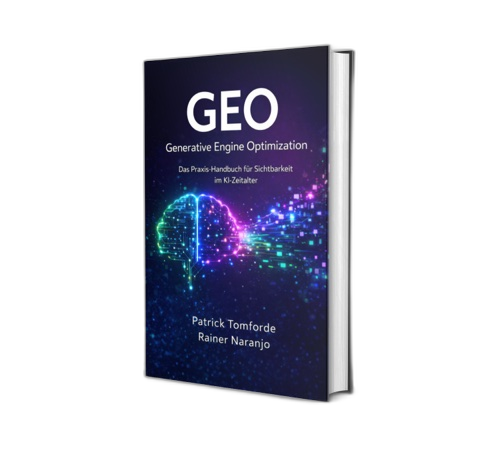


GEO changes how brands become visible in ChatGPT, Perplexity, and Google AI. What the term means and why now is the right time to act.
Generative Engine Optimization (GEO) is the strategic optimization of content for AI-powered answer engines like ChatGPT, Perplexity, Claude, and Google AI Mode. While traditional SEO aims to appear at the top of search result lists, GEO focuses on being cited, paraphrased, and linked in the generated responses of AI systems. The competition for visibility is thus shifting from ten blue links to curated, AI-formulated answers – and this is where it will be decided which brands are perceived.
How the Term GEO Originated
The term Generative Engine Optimization was coined in 2023 in a groundbreaking study by researchers from Princeton University, the Georgia Institute of Technology, and the Allen Institute for AI. The scientists, led by Pranjal Aggarwal and Vidhisha Balachandran, systematically described for the first time how content can be specifically prepared for generative AI systems to have a higher likelihood of being cited in responses.
From our consulting work with Hamburg and international client projects, we see that many marketing professionals initially confuse GEO with "prompt tricks." However, GEO is fundamentally a content-structural discipline: It addresses how language models select, weigh, and weave sources into their responses. This selection can be influenced – and it can be measured. Notably, the first GEO insights initially circulated only in academic circles before, in 2024, the first agencies began to systematically translate them into client projects. performanceLiebe, under the management of Patrick Tomforde, was among these pioneers and was able to develop its own methodological framework early on, based on 15 years of linkbuilding experience and consistently relying on scientifically proven levers.
How AI Search Engines Select Content
Generative search systems operate in two phases: First, they retrieve relevant sources through classic information retrieval components – that is, search engine indexes or vector databases. Then, a Large Language Model synthesizes the collected information into a coherent answer and decides which evidence to cite. In this second phase, the GEO-relevant decision is made. When marketing professionals understand this two-step process, it becomes immediately clear why linkbuilding and on-page optimization are interdependent: Without external trust signals, there is no entry into the retrieval pool, and without structured, citable content, citation does not occur despite entry.
What the models prefer is now well-researched. Content with clear structures, verifiable statements, and trustworthy signals is disproportionately often included. This is where classic trust signals pay off, foremost a healthy backlink graph.
- High-quality backlinks increase the likelihood that a source appears in the retrieval step
- Structured data and clear headings make it easier for the model to extract information
- Concrete statistics and quotes are preferred for embedding
- Recency and date signals are an additional trust anchor
- A recognizable brand with authoritative mentions is cited more often

Why GEO is Business-Critical Now
Traffic from generative answer engines is growing double digits per quarter. Industry analyses from the first quarter of 2026 show that already between 12 and 18 percent of all information-oriented search queries are answered through AI-powered interfaces – with an upward trend. Those who do not appear in these answers gradually lose brand presence, qualified traffic, and ultimately pipeline.
At the same time, the barrier to being cited in answers is lower than in the classic top-3 position. Even domains with previously moderate visibility can catch up significantly through targeted optimization of their content and backlink profile. GEO thus presents a rare opportunity to strategically secure important positions with manageable effort before the competition does. Especially in the B2B segment, we observe that decision-makers in the research phase almost exclusively consult AI answers – those who do not appear as a brand there do not even make it onto the shortlist.
Additionally, there is an economic component: While pay-per-click costs are rising double digits annually in many industries, GEO reach is organic and therefore significantly cheaper in the long term. Once established, a position in AI answers continues to have an effect for months, often years, and noticeably reduces dependence on paid channels. Combined with a sustainably built backlink profile, this creates a visibility foundation that remains effective even when individual platforms adjust their algorithms.
Those who do not appear in the answers of answer engines today will be invisible tomorrow for a growing search segment – regardless of how good the classic rankings look.
The Difference Between SEO and GEO
SEO and GEO share a foundation: Both benefit from technical cleanliness, high-quality content, and a strong link profile. The key difference lies in the target metric. SEO optimizes for rankings, that is, list positions – GEO optimizes for citations, that is, mentions in the AI answer. In our client projects, it is evident that brands that strategically complement their existing linkbuilding momentum with GEO measures grow disproportionately in both organic and AI traffic.
Backlinks remain the most important external trust indicator in both realms. Language models draw their training and retrieval corpus from the open web, where link structures continue to signal which sources are relevant and credible. A strong off-page strategy is therefore not a question of "still SEO" or "already GEO" – it is the common basis of both disciplines. Thus, those who have consistently invested in building a topic-relevant link profile in recent years enter the AI age with a measurable advantage and can directly build GEO measures on that.
Do you want to know how visible your brand already is in ChatGPT, Perplexity, and Google AI Mode? We analyze your current status and show you the quickest levers.
Request Strategy Call NowConclusion
Generative Engine Optimization is the logical evolution of search engine optimization in a world where answers are generated rather than listed. Those who invest early secure mentions in the most used AI assistants and build a visibility position that is hard to replicate. The good news: Much of what you already know about good content and solid backlinks still applies – now only under a new premise. Those who understand this can start with a clear compass and need neither to panic about "the end of SEO" nor to engage in actionism around supposed AI tricks.





 info@performanceliebe.de
 Phone:
  Mobile: